
Paving the Way for Biomedical Innovation
The Frederick National Laboratory meets the nation’s most urgent biomedical research needs and serves as a national and global resource for the scientific community.
What is this?
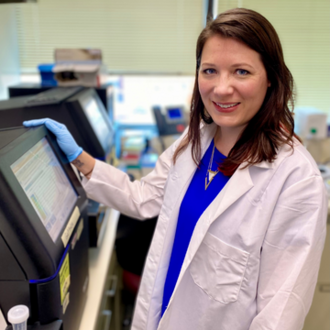
Automated assay machine in the Cancer Genomics Research Laboratory. The lab investigates how genetic variation contributes to cancer susceptibility and disease outcomes.

Initiative
Scientific Standards Hub
Our scientists establish standards and reference reagents for diverse scientific disciplines and encourage the adoption of benchmarks among researchers.
8
disciplines with tools to help bridge gaps in scientific reproducibility.
Initiative
RAS Initiative
The RAS Initiative mobilizes the cancer research community to develop ways to treat cancers driven by the mutant RAS gene in an open model of collaboration among government, academic, and industry researchers.
220,000
People per year in the U.S. are diagnosed with cancers caused by KRAS mutations.
What is this?
Surface representation of the structure of an oncogenic mutant of KRAS in complex with RAS-binding domains of RAF1 Kinase. The GMPPNP bound to oncogenic KRAS mutant is shown in ball-and-stick representation.
Our Passion is Infectious
Shape Your Career
Work with the best of the best biomedical researchers and investigators. Be a part of groundbreaking solutions that benefit public health throughout the world. And, enjoy some of the best benefits in the region. We are looking for smart, passionate problem solvers for benchwork, data science, manufacturing, and more.